
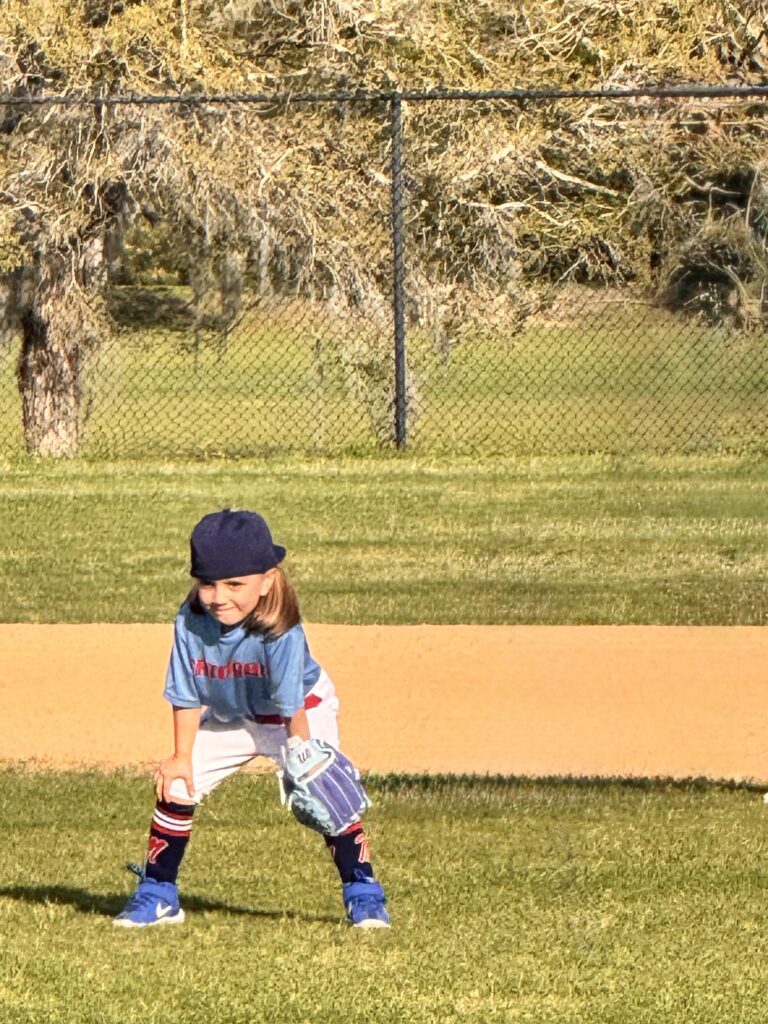
During what was usually one of her favorite activities of the week – T-ball practice – Emily sat sluggishly on the metal bleachers and told her mother, Brittany Lee, that she was “too tired” to play.
During the two-minute walk back to the car, she dragged her feet and begged to be carried. By then, Brittany realized her typically full-of-life 5-year-old was battling something far more serious than a little sleepiness or the flu.
“She never really recovered from that,” she said.
Brittany’s unwavering intuition, followed by a series of blood tests and doctor visits, ultimately led the family to the UF Health Shands Pediatric Emergency Room. Within 30 minutes of arriving, a doctor told Brittany and her husband, Ryan Brown, that there was a 99.99% chance their daughter had leukemia.
Another doctor said, “If I were a betting person, I would bet my next two paychecks that it’s leukemia.”
Emily was assigned a room one hour later and hooked up to an IV to receive blood and plasma transfusions. By the next morning, she underwent her first bone marrow biopsy and began chemotherapy, the first step in an ongoing stretch of months of inpatient hospital stays, transfusions, doctor visits and social distancing.
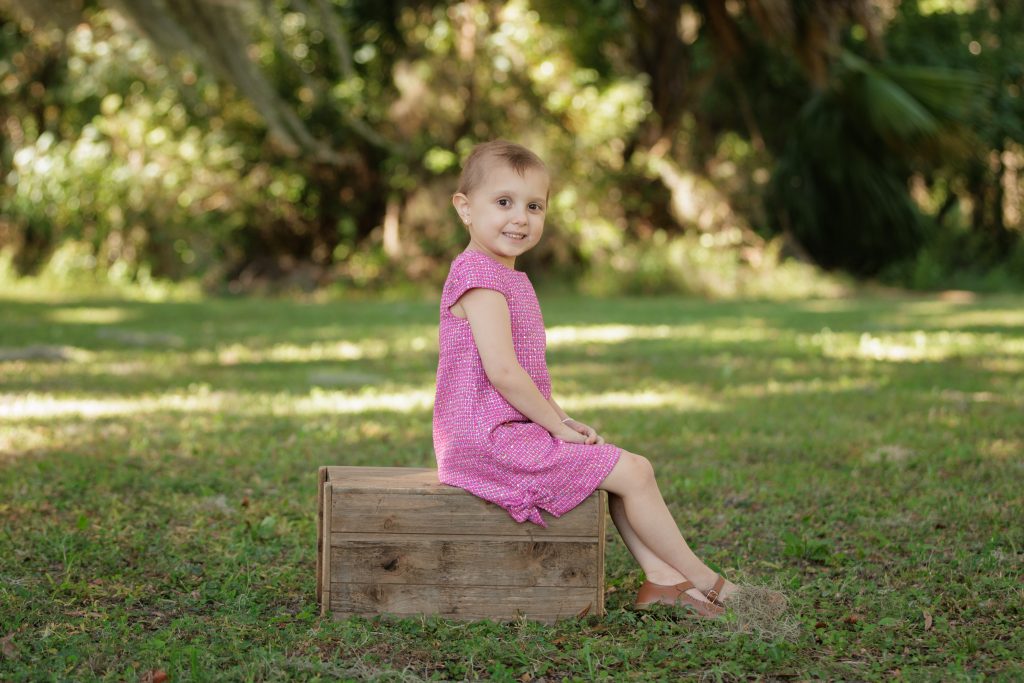
The unexpected afternoon cold has settled over the field near Southwest Archer Road, where we’ve gathered to take photos. Dressed in diamond stud earrings and a tweed pink dress, dotted in golden sparkles and a miniature bow on the side, Emily grips a squishmallow in one fist and her chirping black and yellow cardinal “Tweet Tweet” in the other.
“Look, Tweet Tweet is kissing me,” she shouts as the overhead trees cast their reflection onto a picnic table.
At exactly 5 and three-quarters years old, she carries herself with the demeanor of someone far older – confident, self-assured and full of opinions and requests.
Her once shoulder-length, dirty blonde hair has shrunk into small tufts sprouting from her scalp, a side effect of her chemotherapy. Brittany attempts to comb Emily’s hair down to one side, yet it’s relentless in its mission to stand straight up.
It’s hardly apparent that about seven months ago, Emily was unable to muster the energy to rise from bed in the morning and preferred silence over watching television. For five days in early spring of 2025, she faded in and out of intense moments of lethargy, causing Brittany to assume that she had simply caught the flu or a bug from classmates.
“She just [had a] complete lack of energy that it was very clear that there was something else going on,” Brittany said.
The pair decided to visit an urgent care, where a doctor performed a strep test that returned negative. Brittany texted her friend and Emily’s primary pediatrician, Dr. Mary Grooms, who said that if she wasn’t feeling better in the next day or two, she should come into the office. The following day, Emily’s fatigue had not improved, and the series of swabs at her primary care facility continued to confirm negative results for common illnesses like the flu.
Dr. Grooms alerted Brittany to follow up with another appointment if the symptoms recurred. Two weeks later, Emily became lethargic again, leading to repeated tests and a similar assumption that it was a viral infection, yet a warning that she would require a blood test if it happened again.
When it returned for the third time, Dr. Grooms ordered a blood panel and called Brittany, who had traveled 40 minutes away for a work conference, the next day.
“Where’s Emily?” Dr. Grooms immediately asked.
Brittany explained that she had left Emily at home with her grandfather because she was too sick to attend school that day.
“Tell him to meet you at Shands’ [Hospital] with Emily,” she said. “This cannot wait.”
“It was very rough,” are the only words Brittany could use to describe the emotional rush of the initial two-day hospital ordeal. Thursday: a race to the emergency room, blood transfusions and numerous doctors confidently expressing their conviction that it was leukemia. Friday: lumbar punctures, a bone marrow biopsy and the first day of chemotherapy. Several days later in May, formal confirmation from the biopsy arrived, officially diagnosing Emily with B-cell acute lymphoblastic leukemia (B-ALL).
“I never for a second considered it was going to be something as serious as leukemia,” Brittany said.
B-ALL is a rare blood cancer that affects the development of the white blood cells known as B lymphocytes, which form inside bone marrow and help the body fight off infections. When they become abnormal due to cancer, these cells can spill from the bone marrow into the blood, quickly spreading throughout the body, according to the Leukemia Research Foundation.
Emily’s form of leukemia progresses extremely quickly and leads to the sudden onset of severe symptoms, such as fatigue, swollen lymph nodes, joint and abdominal pain, unexplained weight loss or excessive bruising or bleeding, the foundation wrote.
The five-year survival rate for children with B-ALL is above 90%, and 85% of children with the illness remain cancer-free after five years, according to the foundation. But the process of removing the cancer includes harsh and uncomfortable treatment, including chemotherapy and medications, for typically two to three years.
Emily’s treatment is divided into blocks, each with its own schedule and location. Her current block consists of an inpatient stay at UF Health Shands Children’s Hospital from Monday to Sunday morning, yet the exact dates can vary, every other week, where she receives chemotherapy and blood tests.
The previous block allowed Emily to wear a backpack with a pump connected to her port, offering chemotherapy 24 hours a day for 28 days straight. Emily can sleep in and shower in the backpack, which she has never complained about, Brittany said.
Next month, Brittany believes Emily will return to another block of treatment with the backpack pump, although she admitted that she hasn’t read beyond their current block on the information sheet. Treatment is expected to end on Aug. 19, 2027.
Since Emily spends a majority of her time in and out of the hospital, and due to her suppressed immune system, she is unable to attend kindergarten in person at Queen of Peace Catholic Academy. Instead, her teachers have saved a seat for her at Table Two and placed a teddy bear labeled with her name to hold her spot in the classroom.
Emily Zooms into class and can stay up-to-date with most of the lessons, Brittany said, interacting with her classmates through an iPad that the teacher occasionally turns around to show students. The virtual classes have helped maintain a sense of normalcy in Emily’s otherwise hectic and unusual routine.
“Normal is never something I thought I would strive for as a parent because you want your kids to have the best childhood,” Brittany said. “You want them to excel in everything, you want everything to be better than normal. But we are definitely in our striving for normal phase.”
The Child Life Specialists at UF Health Shands Children’s Hospital have also become an essential resource in helping Emily understand her diagnosis and stay connected with others, Brittany said, even if her life has become one of white coats and hospital floors.
When Emily first arrived atUF Health Shands Pediatric Emergency Room, she was immediately greeted by a staff member from its Child Life Program. The program provides certified professionals to work with children and families, easing the stress and anxiety associated with hospitalization, according to UF Health’s website.
Brittany described UF’s Child Life Specialists as a lifeline, partially due to their ability to introduce Emily to her diagnosis and each step of her treatment in a language that isn’t intimidating, confusing or scary.

“I didn’t really have to do much of the heavy lifting there because from the very beginning, there was always someone from Child Life there,” she said.
When Emily first received her port access, a Child Life Specialist entered the room to explain what the port would look like. Before losing a significant amount of hair from chemotherapy, one of her specialists, Katie, gifted her Samantha: a hairless American Girl doll dressed in a white coat and scrubs and fitted with a sewn-in port.
Specialists, volunteers and interns from the program visit Emily throughout the day during her inpatient hospital stays to play board games, craft, discuss future treatment steps and listen to her list of never-ending dad jokes. If she has to attend an infusion center for the day to receive medicine, her two assigned specialists, Katie and Maddie, stop by for the day.
Emily’s passion for her specialists is difficult to miss – her face immediately lights up at the mention of Ms. Katie or Ms. Maddie, a giggle escaping her mouth between bites of McDonald’s chicken nuggets.
Katie Walker, a Certified Child Life Specialist with UF Health, described the program as an opportunity to promote overall well-being and coping mechanisms for the entire family, according to a Facebook video published by UF Health.
“The hospital can be a scary and overwhelming place, and Child Life plays an important role in promoting psychosocial well-being both for our patients and their siblings and their families,” Walker said in the video.
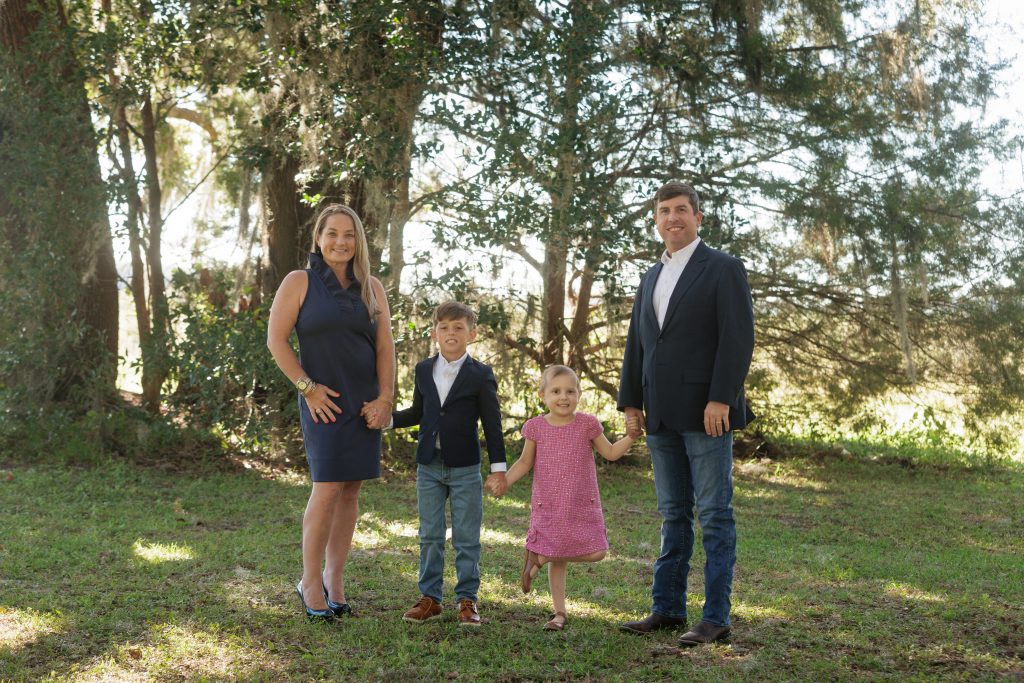
The program has also offered a sense of respite for the busy couple. Brittany, who serves as the vice president of Gainesville’s Florida Blue Farms, Inc., and Ryan, a P.E. teacher at Queen of Peace Catholic Academy, have had to juggle their careers and raise their 8-year-old son, Jeb, while keeping up with Emily’s medical schedule.
“I think this is just a secondary effect, but they [Child Life] allow her the opportunity to be a kid and laugh and have a good time in a hospital setting,” Brittany said. “As her parent, it’s comforting. It’s helpful for me to be able to see her enjoying herself.”
When asked how she’s doing, Brittany stared off and sighed, unable to offer an answer.
“I don’t know,” she said. “I don’t know that I’ve taken lots of time to reflect. I think we’ll do that when we’re done. I think now we’re just like, ‘Let’s get it done. Let’s take care of it.’ And then in August 2027, we’ll have a couple [of] minutes.”
In the meantime, Brittany said she and her husband have worked to divide and conquer their parental duties in an effort to offer both children as many opportunities as possible.
One of their biggest goals is that Jeb doesn’t miss out on his own childhood, Brittany said. Ryan has taken on much of that responsibility, focusing on taking Jeb to all of his sports, camps and academic activities.
“Balancing our daughter’s fight with leukemia and keeping life steady for our son has been the most important work of my life,” Ryan said. “Our son keeps me grounded in the everyday moments that still make us a family.”
Jeb appears to hold a special place in Emily’s heart – his loud, boyish mischief softens when Emily tightly wraps her arms around him, her shoulders slightly relaxing.
Brittany described the duo as a team and said Jeb is often the first person Emily asks for when in the hospital.
“The first thing she wants to do is FaceTime Jeb, talk to Jeb,” she said. “He’s definitely the most important person in her life.”
Brittany hopes that Emily’s diagnosis and the family’s experience can serve as a testament to parents to advocate for themselves, their children and their gut feelings.
“If you think something is wrong, don’t ignore it,” she said. “Look into it until you’re satisfied that it’s resolved or you have found some sort of answer.”
Balancing Emily’s treatment with the stress of everyday life, careers and parenting has pushed Brittany, who considers herself to be a Type-A individual that does not typically need help from others, to realize the necessity of accepting help from others and leaning on a support system.
For Brittany, this support group has included her family, friends, faith and their pediatrician, but most importantly Emily, whose unbothered “let’s get this over with” attitude seems infectious.
“I think she’s really shown strength and resilience,” she said. “I knew she was a tough kid, but [I] definitely did not know how tough.”
This sentiment is shared by Ryan, who agrees that Emily’s strength is bold beyond her years.
“Watching her courage has changed me — it’s shown me resilience, grace and how far love can stretch through fear and exhaustion,” he said.