
Beginning with the 2026-2027 school year, high school student-athletes will be required to undergo and pass an electrocardiogram (EKG or ECG) at least once before competing in school athletics.
The requirement comes with the passing of Florida Senate Bill 1070. The bill states that, as a part of the “Second Chance Act,” these athletes must pass an EKG and be medically cleared based on standards established by the Florida High School Athletic Association (FHSAA) before participating in any form of interscholastic sports.
According to the bill, students with abnormal EKG results will be prohibited from participating in physical activities until they provide medical clearance from a specified health professional.
Taking effect July 1, this act allows some exceptions. The bill states that students who received an EKG within two years before the 2026–2027 school year or who have already competed in FHSAA sports are not required to complete the screening. Parents can also object in writing to the exam for religious reasons or secure a medical exemption from the EKG from a health professional.
As families rush to schedule exams for their teens, questions and concerns have emerged about how to access the exam, what it means for their child and the potential financial impact.
What is an Electrocardiogram?
An EKG is a 5- to 10-minute test that records the electrical signals generated by the heart. The exams help to check the heartbeat and diagnose heart attacks and irregular heartbeats, or arrhythmias, according to the Mayo Clinic.
Doctors perform these painless exams by placing sticky patches on the chest — and sometimes the arms and legs — and connecting them to an EKG machine. The machine then translates and records the electrical impulses to show heartbeat rhythm and the timing of impulses through different parts of the heart, according to John Hopkins Medicine.
Impact on Your Child’s Health
Dr. Mohammad Al-Mousily, a pediatric cardiologist and the director of pediatric and congenital electrophysiology at the University of Florida, said that the leading cause of death in young athletes during sports is cardiovascular, with about 75% of fatalities being cardiovascular-related.
In the past, student-athletes were typically required to undergo a history and physical exam to assess cardiovascular risk, he said. These exams consist of a pediatrician asking questions about family history of sudden deaths during youth. Questions also include whether the patient has experienced symptoms like chest pain while exercising, fainting or heart palpitations. Pediatricians then perform a physical evaluation, including listening to the heart, to assess for issues that may arise during sports or lead to sudden cardiac arrest.
“So one of the reasons why we do history and physical and why the EKG rule is really being developed is because we know that the most common reason that kids can have an issue while playing sports or even at rest is related to the heart,” Dr. Al-Mousily said.
But physical and history exams are not always reliable for detecting cardiac abnormalities. A majority of patients who have a sudden cardiac event showing no physical symptoms before or abnormalities during their physical exam.
These physical history exams have a low sensitivity of about 10% to 20% and a high flag rate, Dr. Al-Mousily said. This means that physical history exams they are not always accurate at identifying which patients will have a problem or their likelihood of a cardiac event.
“When you add an EKG to that [physical and history exams], the sensitivity increases to about 90%,” he said. “Data shows that the EKG is a far better test than history and physical at identifying disease that may cause issues in patients where they may be asymptomatic otherwise.”
Dr. Al-Mousily said that if there is a way for doctors to reduce the risk of sudden cardiac events, such as through EKGs, then they should use those tools as much as possible.
“[The] intentions of this requirement are to really try to capture those patients who, unfortunately, were not captured before they had an event, and screen them out,” he said.
Dolores Anne, a registered nurse in Gainesville, said that she believes this new requirement is a wonderful concept. An EKG is a first-line diagnostic test, she said.
“As a parent of an athlete, I believe it’s a valuable way to detect possible underlying heart conditions,” Anne wrote. “ECGs are not routinely ordered for teenagers as they grow, and sometimes serious conditions can go unnoticed until it’s too late. Early screening could help identify risks before they become life-threatening.”
Although EKGs are a better tool, Dr. Al-Mousily said, broad community screenings are not supported by all doctors and national physician organizations. This is mainly because of concerns about cost and the ability to offer them equitably without straining the health care system.
The American Heart Association and American College of Cardiology state that, according to contemporary scientific evidence, adding an EKG to the H&P (history and physical exam) is “deemed reasonable,” but only when EKG results are interpreted by clinicians trained in athletic EKGs and when appropriate follow-up care is available and accessible to all athletes being screened.
What Does an EKG Cost in Florida?
Gainesville parents have raised concerns about the cost of the required exams, with some arguing that if schools and the Senate mandate them, they should cover the expense. Some also fear that the new requirement will keep low-income students out of sports.
Other parents say this will add an extra cost to their budgets, but they will find a way to afford it.
Wendy Sipes, whose son is in high school and plays sports, said she had her son undergo an EKG, which was not expensive.
“It’s called being a parent,” she wrote. “This absolutely should be a requirement.”
According to the bill, each school district is required to seek “public and private partnerships to provide low-cost EKGs for students,” including an EKG exception for students who live in a county where a district cannot provide the exam for less than $50.
Dr. Al-Mousily said there are also pediatric practices and organizations that aim to offer more affordable exams, such as UF Health and Who We Play For, a nonprofit that provides affordable heart-screening events and $20 EKGs.
Although the requirement is $50 or less, Dr. Al-Mousily said that most places charge $20 to $30 for the exam. There are also discussions about creating funds to offer financial help for the uninsured or underinsured to afford and access appointments for these evaluations, he said.
“When you make rules, then you have to think of equity in healthcare, so you have to make sure that there is equity in patients who have resources and who don’t,” he said. “The goal is to have this available to not just people who have the means, but also [those] who don’t.”
Dr. Al-Mousily said he foresees many schools offering annual screening events, and doctors, organizations and the legislature are continuing to search for ways to ensure the requirement won’t place a strain on the community or the healthcare system.
Debate Over EKG Access
Parents seeking an EKG for their child typically receive a referral from a pediatrician to a cardiologist, or they visit an urgent care, walk into an outpatient clinic or schedule an appointment at a cardiology facility.
But according to Dr. Al-Mousily, this new requirement raises concerns about access, particularly the difficulty of getting into a pediatric cardiology office when large numbers of patients are being referred.
This often happens when the clinicians performing the EKGs are not fully competent or do not understand the International Criteria, a set of guidelines that define normal and abnormal EKG findings and determine when a patient should be referred to a cardiologist.
When clinicians lack familiarity with these criteria, they may over-refer patients who do not actually need cardiology care, which leads to longer wait times, overwhelmed facilities, unnecessary parental anxiety and added financial stress from follow-up appointments.
“You have to make sure that the ones who are being referred to those things truly need those things, that the EKG is being read appropriately and also have something set up that can provide help to the families that don’t have those resources,” Dr. Al-Mousily said.
This includes working to build relationships with pediatric offices and communities to offer training on how to read these EKGs correctly, or to read them for them, he said, so that patients don’t have to come in when they really don’t need to.
For example, Dr. Al-Mousily works with a pediatric practice that has centers all the way in the Panhandle and into Ocala, with EKG machines in their offices. Medical professionals perform the EKG and send it to Mousily for review; if he determines it is necessary, he then refers the patient to a pediatric cardiologist.
Since Florida is the first state in the country to enact this requirement, Dr. Al-Mousily said it is still a bit of a guinea pig right now in setting up this law and creating systems to make it work efficiently.
“If the EKGs are not read appropriately, and too many patients are flagged, but they’re truly normal, then it may put a strain on the system, and so then it’ll be a way for us to know that we need to work on making the system better to be able to do this appropriately,” he said. “We’re still kind of in that period of finding out whether it can be done appropriately in our communities.”
UF Health has already partnered with select pediatricians to perform EKGs in their offices and offers screenings in its own clinics. Dr. Al-Mousily also said UF is working to make EKGs available in its offices at the school and at other locations.
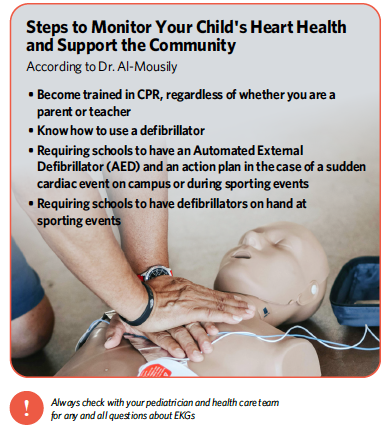
To address worries, Dr. Al-Mousily said parents should know that an abnormality in an EKG does not necessarily mean their child has a cardiac disease; it just means they might need some follow-up. Because no screening test is perfect, all members of the community should be prepared to respond to a sudden cardiac event.
“This is why CPR training and having AEDs [Automated External Defibrillators] available is important and is supported by all national organizations and physicians,” he said. “Those are things that really do save lives … knowing what those resources are in their local schools and their local communities only really reduce the likelihood of an issue.”