
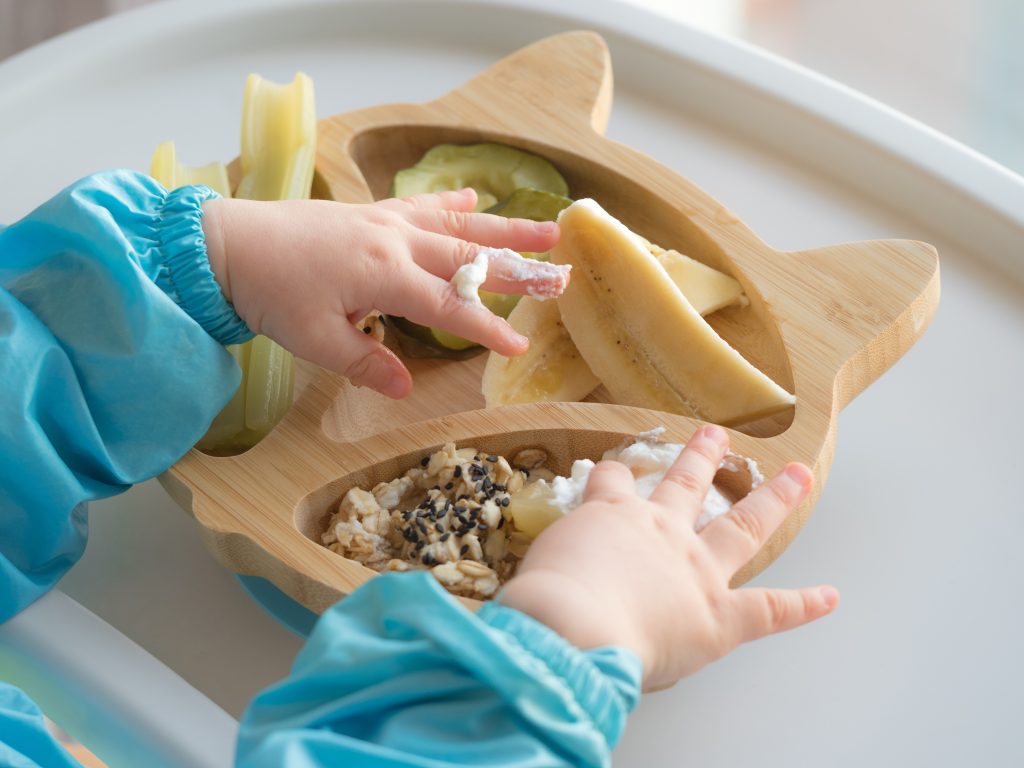
For parents, mealtime often means chaos and cleanup — pureed carrots on the ceiling, spaghetti noodles up your child’s nose, a tiny fist full of sliced green beans.
But you might want to reconsider rushing over with the wipes after every bite. Research and parent perspectives indicate that embracing the messiness can enhance your baby’s cognitive, motor and sensory development.
Messy Food Play Can Improve Fine Motor Skill Development
Messy food play can be best defined as encouraging your child to discover different smells, textures and tastes through playing with their food, according to Sheffield Children’s NHS Foundation Trust, which can lead to a bit of disarray.
Allowing your child to experiment with their food, meaning they might have to smear it across their face or crush it in their hands, can improve their motor skill development by supporting the use and focus of their hands and movements.
According to an article from the Boston Ability Center, behaviors as simple as picking up a tiny piece of fruit with their fingers or pulling apart green beans can help to strengthen finger and hand muscles, therefore improving hand-eye coordination and dexterity. This can come in handy as your child grows up and moves to elementary school, enhancing their ability to write, dress themselves and perform intricate tasks.
Promoting Mealtime Messes Can Aid in Creativity and Sensory Development
Allowing your child to “play” with their food can offer an opportunity to engage in pretend play, showing curiosity while touching foods such as mashed bananas or sweet potato. An environment that promotes imagination, especially with food, can improve the overall mealtime experience for the whole family, according to the Boston Ability Center.
Exploring food can also play an integral role in your child’s sensory development by introducing them to new textures, smells and tastes. According to Child and Family Development, research has shown that for your baby to be comfortable with certain food textures and flavors, they need repeated exposure to them.
Food Play Can Encourage Positive Eating Patterns and Food Associations
Mealtime messes and food play can take the pressure off of eating, transforming it into less of a controlled “you have to eat this” environment, into something enjoyable and exploratory for your child.
According to Empower Kids Therapy, food play can remove the stress of new foods and establish curiosity around trying new meals. This, in combination with the ability to discover new senses, can decrease the likelihood of a large range of strong food dislikes and sensitivities.
Messy Mealtime and Food Play Strategies
According to Sheffield Children’s NHS Foundation Trust, it is recommended that food play be kept separate from mealtime. As advised by the hospital, this can be done by placing puree on your child’s food tray and adding hard plastic toys like teethers. You and your child will then explore the objects together, allowing them to get a sense of different textures and movements.
As you play with the puree and objects together, communicate with your child. If they are unable to speak, point out the objects, laugh or make sound effects. For older children, if they can form words or phrases, play pretend together or ask them to describe what they feel.
According to an article from Thrive Together, this open communication during food play can help your child learn how to “apply descriptive language,” an important skill to have in everyday life.
To avoid having to mop the floor after every meal or food play experience, consider using a silicone food catcher bib. A large rubber mat can also be placed underneath your child’s feeding chair, helping you to save time and energy during the clean-up process. The mat can be rinsed down after every meal and any scraps thrown away.
Utilizing simple food play methods like these can prevent damage to your home while allowing your child to experience the joys of getting dirty.