
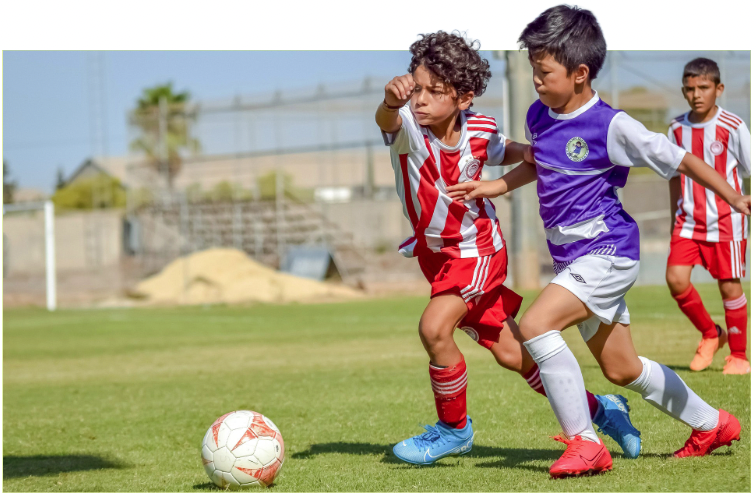
With the return of fall and the school year, keeping young athletes safe is a priority for many families.
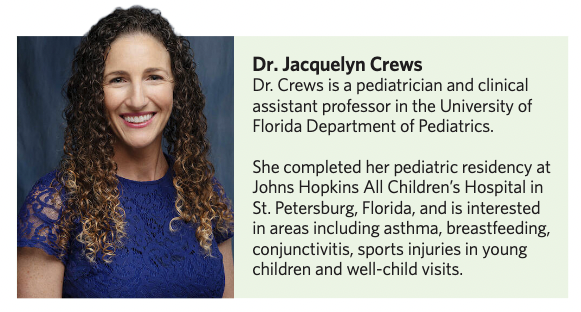
To learn how parents can prevent injuries and know what to do if one occurs, we spoke with Dr. Jacquelyn Crews, a pediatrician and clinical assistant professor in the University of Florida Department of Pediatrics.
What’s the most common sports injury (injuries) you see in kids once the fall season kicks in?
The main injuries for the fall season are concussions as well as body injuries, including sprains, strains and bruising. Football and soccer are two of the more popular sports in the fall season; combined with the contact nature of these sports, we see many injuries relating to their play. We also see a lot of overuse injuries, including in shoulders, elbows, knees and ankles.
Kids’ bones and joints are still growing. Does that change how an injury should actually be treated compared to an adult with the same injury?
That’s a great question, and the answer is yes. Growth plates are a weak part of the bone, so it takes less trauma to the area to cause the same injury as a fully mature bone.
An athlete can also get injuries from repetitive pulling on growth plates from overuse. We can often treat overuse or strain injuries conservatively with rest, ice and sometimes stretching/ strengthening exercises with physical therapy. Because fractures in the growth plate can impact that bone’s ability to grow, these injuries are often treated with casts to promote healing.
A kid says something hurts but still wants to play. What steps should a parent take to figure out if it’s a “walk it off” or a “sit this one out” situation?
If a kid immediately can’t “walk it off” or bear weight on an injured leg/ankle/ foot, that’s a good indication they should not return to play until they are medically evaluated. A twisted ankle or strained muscle that is uncomfortable but not causing significant pain is probably OK to return immediately.
A similar approach should be taken to injuries of the arms and hands, where if there is immediate and significant pain or an obvious deformity, the child should not return to participation until evaluated. Head injuries should be taken seriously for concussion, including symptoms such as confusion, headache, dizziness, nausea or blurry vision.
What’s the earliest sign(s) of overuse injury that gets missed because it just looks like normal soreness?
Overuse injuries present as a certain type of movement causing pain that can be reproduced every time the child does that motion. For example, a volleyball player with pain on the front of their knee every time they squat to jump. Or a baseball player with elbow pain when straightening the arm.
It’s usually able to be pointed to pretty specifically by the child. If the pain normally goes away with rest but then seems to take longer to resolve or starts affecting the athlete’s ability to perform the movement, they may have an overuse injury.
Is there an age where you’d tell a parent, “No, not this sport yet?”
Every decision like this comes with potential risks, so it’s up to the family to decide what is best for them. I would never tell a child they can’t participate in a sport, but they should start at a level that allows them to be safe and understand how to participate correctly.
Further, the child should be coached by a trainer who understands that young children are susceptible to injuries and how to start at the child’s level and appropriately advance them through the sport. Children should always use appropriate (and appropriately fitting!) protective gear, including for practices.
If a child/teen gets hit in the head during practice and seems fine an hour later, are they in the clear, or should their guardian still be watching for something?
That would require a pretty nuanced answer based on the injury that occurred. If it was a mild head injury and no concussion is suspected, then the child might be clear to return to the activity. Otherwise, without having more information, I would not give an “all-clear” after one hour, because while concussion symptoms do generally appear within minutes to hours after the initial head injury, symptoms could be delayed up to 72 hours.
A second head injury occurring before the athlete is fully healed from the first could cause serious long-term issues. For significant or questionable head injuries, I would recommend the child be evaluated by a medical professional before returning to play.
How young is too young to start weight training or conditioning for a sport?
The American Academy of Pediatrics actually has guidance on this specific subject. Because children reach adult levels of balance and posture control around 7 to 8 years old, this would be a safe time to start weight-training or sport-specific conditioning.
This type of training should be age- and ability-appropriate and supervised by a knowledgeable coach. Children can really start with resistance training, like using their body weight to build strength. Think hopping on one leg and push-ups.
What’s a mistake that well-meaning parents make that can actually make an injury worse?
I find in both pediatrics and parenting that there is a fine line between building character in young athletes and keeping the body healthy. Parents may want to push their children to perform at the top of their sport, but sometimes rest to heal an injury would be better in the long run than pushing through it. Heavy focus on a single sport year-round can cause overuse injuries, so cross-training or off-seasons are important for proper rest.
Finally, over-emphasizing competition in young ages could prevent learning proper technique and game rules, which could lead to injury. For beginner athletes, focusing on the enjoyment of the activity and learning correct form are most important.
Related Articles
A Pediatrician Q&A on Heat, Hydration and Sun Protection